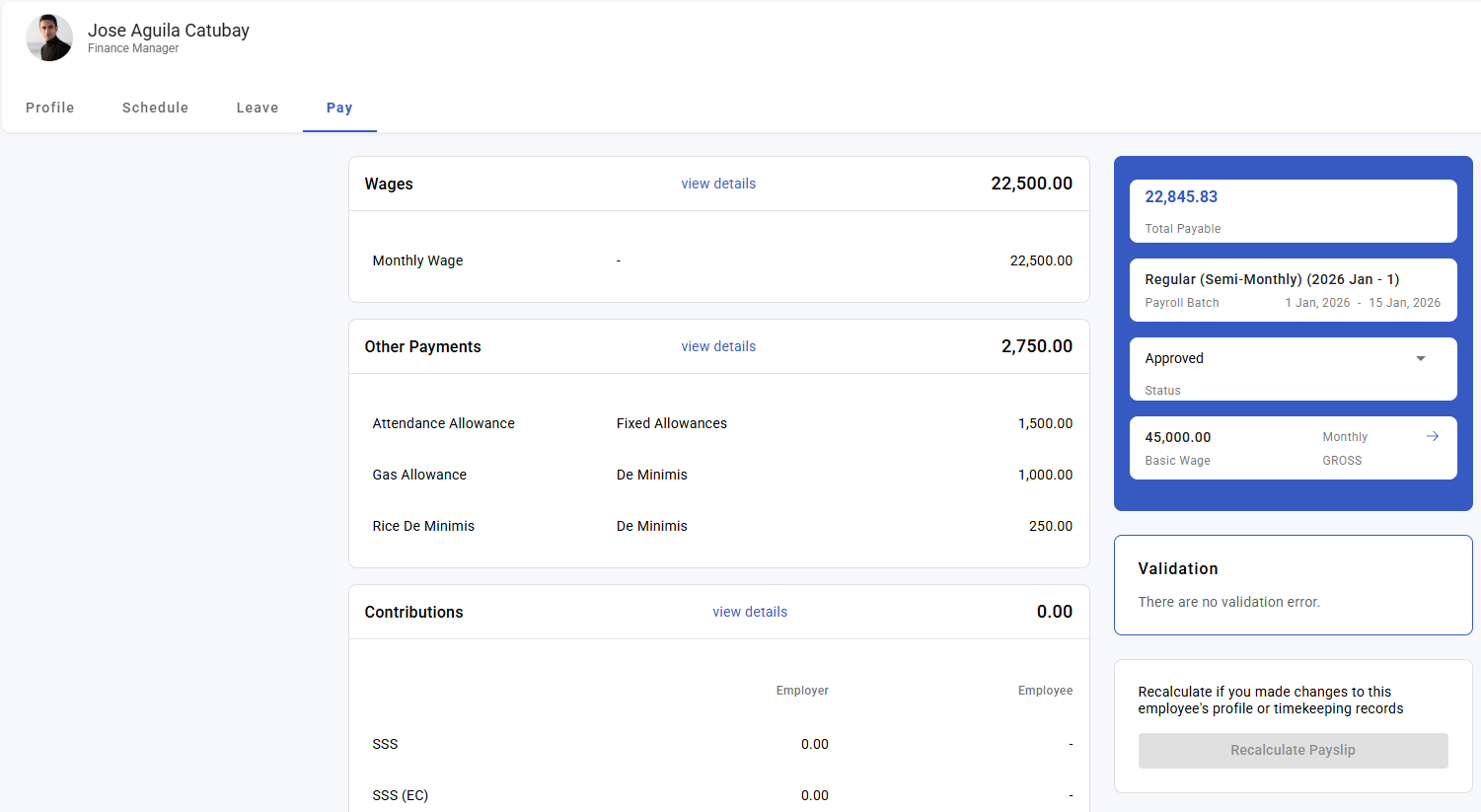
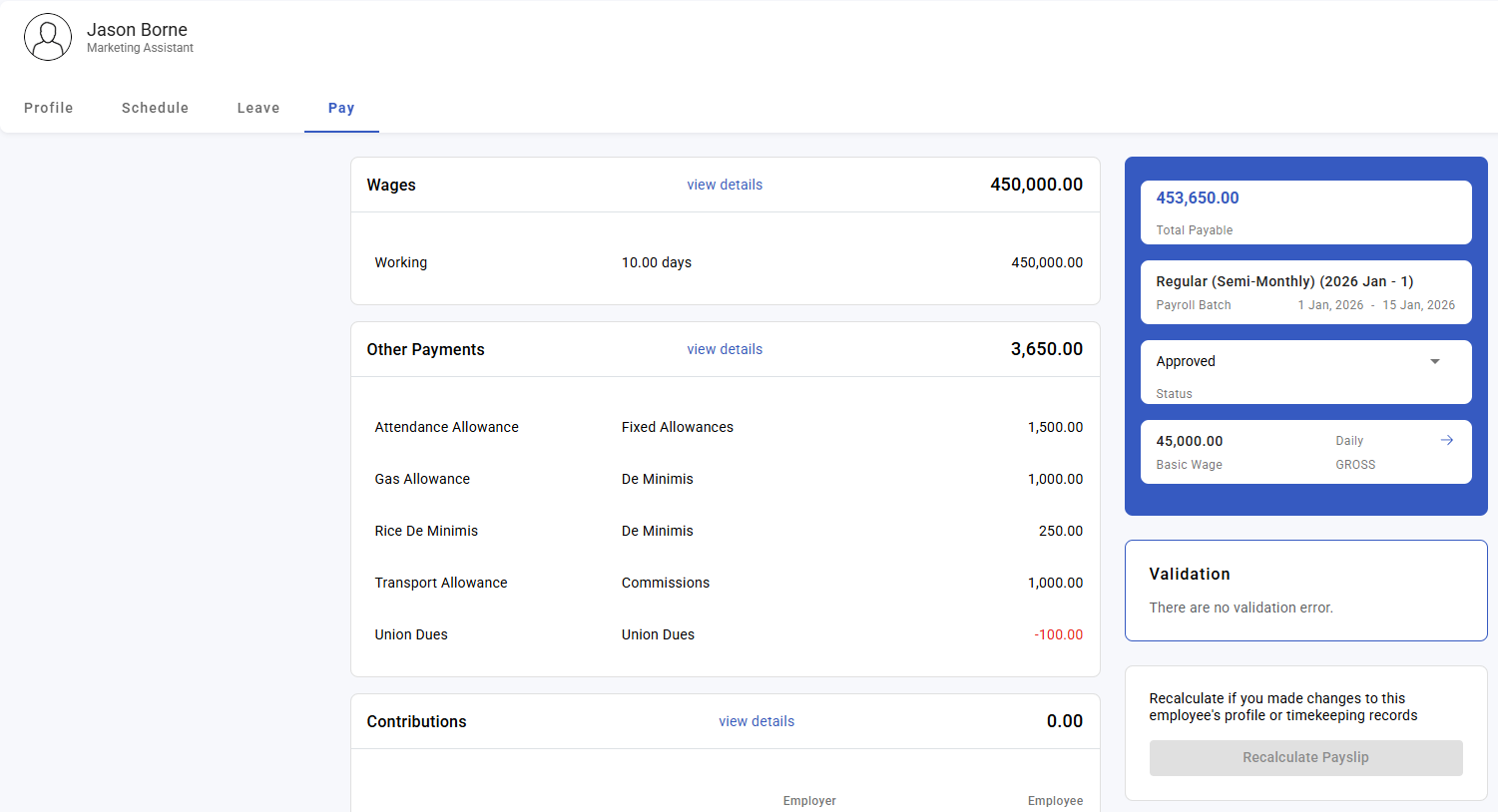
Daily-paid, monthly-paid and hourly-paid employees
An employee's wage period decides what their base pay means: a fixed amount each month, a rate for each day rendered, or a rate for each hour. It is set per employee and it changes how nearly everything else on their payslip behaves.
Where: My Team › the employee › Payroll settings You need: the rights to edit employee payroll settings
Which one, when
| The employee is paid | Wage period | Base pay is |
|---|---|---|
| A fixed salary each month | Monthly | The monthly wage, spread across the payroll cycles in the month |
| A rate for every day worked | Daily | The daily rate for the days rendered |
| A rate for every hour worked | Hourly | The hourly rate for the hours rendered |
There are three wage periods, not two. Hourly is easy to overlook and is the right answer for genuinely part-time and casual staff — using Daily for them forces you to express fractions of a day.
Monthly-paid
Base pay is the monthly wage divided across the payroll cycles in that month, then prorated if the employee was only employed for part of the period. On a semi-monthly cycle, each payslip carries half the monthly wage before anything else is applied.
The consequence people find surprising: the base pay line does not shrink because someone was absent. Pay for time not worked is resolved through attendance — days and hours are credited by their activities, and unpaid time simply is not credited. See Activities and how they pay.
Proration is what handles a genuine part-period: someone who joins or leaves mid-cycle gets a percentage of the cycle's pay.
Daily-paid
Base pay is the daily rate for the days actually rendered. There is no deduction step, because unworked days were never added.
KAMI still derives a notional monthly wage internally — the daily rate multiplied by your monthly wage days — because contributions and income tax are monthly concepts and need a monthly figure to work from. That derived figure is why the wage basis matters just as much for daily-paid staff as for salaried ones; see How wages are calculated.
Hourly-paid
Base pay is the hourly rate for the hours rendered. The same notional-monthly derivation applies, this time as rate × monthly wage days × expected working hours.
What Happens Next
- The wage period is read when the payslip is calculated, and the resulting rates are stored on that payslip. Changing an employee from monthly to daily does not alter payslips already calculated.
- Contributions and tax work from the monthly figure — real for monthly-paid staff, derived for daily- and hourly-paid ones.
- Overtime, night differential and holiday pay are priced from the derived daily and hourly rates in every case, so they are affected by the wage period indirectly.
Tips
- Set the wage period before the employee's first payroll run, not after. Changing it later leaves you with history computed two different ways.
- Do not use Daily as a workaround for part-time. If someone works four hours a day, Hourly expresses that honestly; Daily forces a half-day fiction that then flows into overtime and contributions.
- Check the derived monthly wage for daily- and hourly-paid staff. It drives their contributions, and if the monthly wage days figure is wrong, their statutory deductions will be wrong in a way that is hard to spot on a single payslip.
- Expect daily-paid pay to vary between cycles — that is the point of it. Variation is not evidence of an error.
Troubleshooting / FAQ
Q: A monthly-paid employee was absent but their basic pay line is unchanged. That is how monthly pay works — the base is the monthly wage across the cycle. Unpaid time is reflected through attendance, not by cutting the base line.
Q: A daily-paid employee's contributions changed even though their rate did not. Contributions work from a monthly figure. For daily-paid staff that figure is derived from the rate and the monthly wage days, so anything that changes the wage basis changes it.
Q: Can one employee change wage period mid-year? Yes, but payslips already calculated keep the basis they were calculated on. Decide from which cycle the change applies and recalculate only from there.
Q: Which should a probationary employee be? Whatever their contract says they are paid. Probation is not itself a wage period.
Screenshots
These screenshots came from our previous help centre and may show an earlier version of the interface.