Custom Policies
Custom Policies are the policies employees must read and acknowledge. Where a reference document sits in a library for people to consult, a custom policy is an obligation: KAMI presents it, records that the person accepted it, and gives you the evidence afterwards.
Where: My Team › Settings › Custom Policies
You need: the company policies right 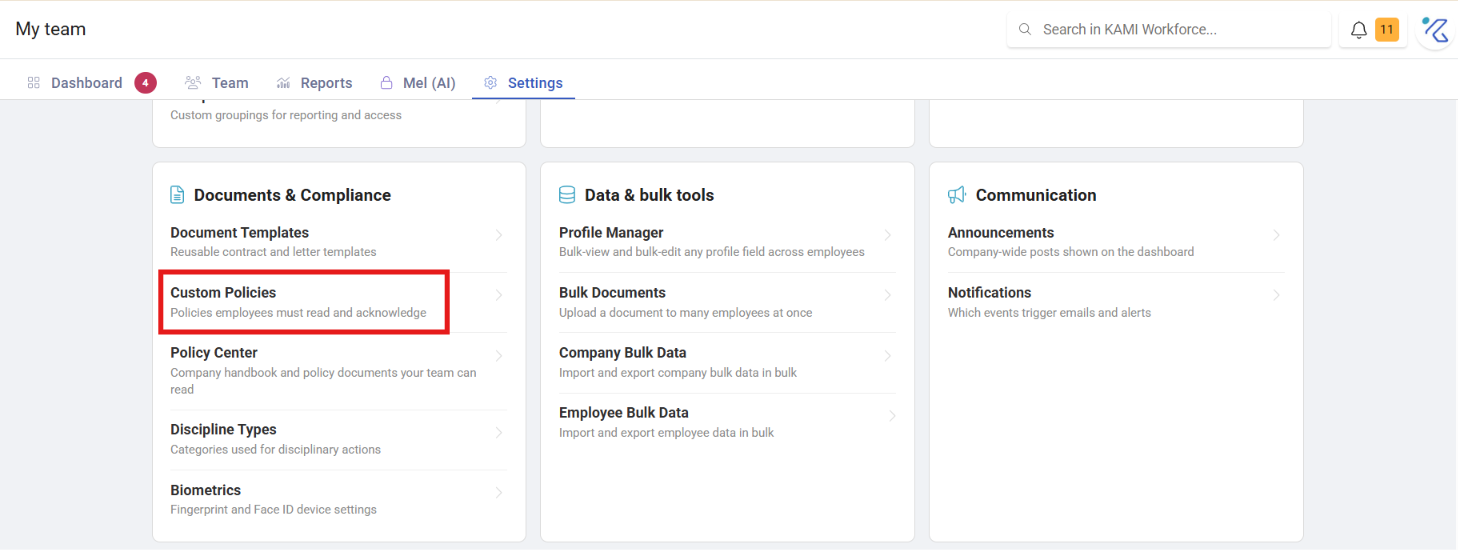
Policy Center or Custom Policies?
These are genuinely different things with confusingly similar names:
| Policy Center | Custom Policies | |
|---|---|---|
| What it is | A library your team can read | A policy people must accept |
| The employee's action | Optional — they look it up | Required — they acknowledge it |
| What you get | Availability | A record of who accepted, and when |
| Use it for | Handbooks, guides, reference | Codes of conduct, IT policy, anything you may need to evidence |
The evidence is the point. If you would ever need to show that someone was told, it belongs here rather than in the library.
What Happens Next
- The policy is presented to the employees it applies to, who must acknowledge it.
- Acknowledgement is recorded per person, with a timestamp — that record is what makes the policy useful in a dispute.
- People who have not yet acknowledged remain outstanding until they do; the policy does not quietly lapse.
Tips
- Only make mandatory what you would actually enforce. Every mandatory policy costs each employee attention, and a long list of acknowledgements teaches people to click through without reading — which destroys the evidentiary value you created it for.
- Re-issue after material changes. An acknowledgement of last year's version is not an acknowledgement of this year's, and treating it as one is exactly the assumption that fails under scrutiny.
- Check the outstanding list before you need it. Discovering during an incident that the person involved never acknowledged the policy is the worst possible time.
- Keep the wording plain. A policy nobody can understand is one nobody can be held to, whatever the record says.
- Pair with Document Templates where the policy needs a signed copy rather than an in-app acknowledgement.
Troubleshooting / FAQ
Q: Someone says they never saw a policy they acknowledged. The record shows the acknowledgement and its timestamp. That is the record's purpose — though it is worth asking whether the presentation is doing its job if this happens often.
Q: We changed a policy — do people need to re-accept? KAMI records acknowledgement of what was presented. For a material change, re-issue it; anything else leaves you evidencing the wrong version.
Q: Where do I put a document people just need to be able to find? Policy Center.