Requesting and liquidating an advance
An advance is money given to you before you spend it — for travel, a client event, or a purchase you should not have to fund yourself. In exchange, you owe an account of how it was used. That second part is called liquidation, and the advance is not finished until it is done.
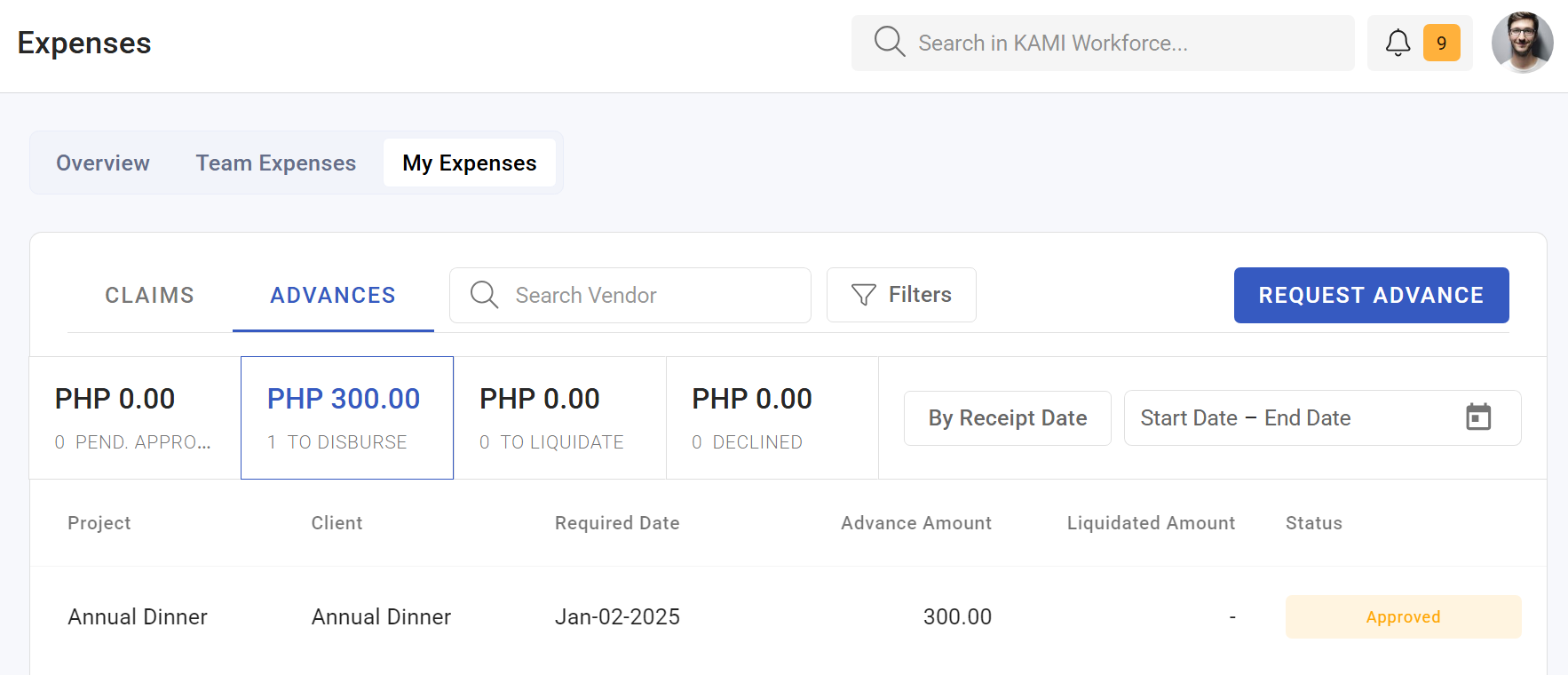
Where: Expenses › My expenses › Advances You need: nothing special, where your company offers advances
Advance or claim?
| You are | Use |
|---|---|
| About to spend, and should not fund it yourself | An advance |
| Have already spent your own money | A claim |
Ask for an advance before the spend. Asking afterwards is a claim, whatever it is called.
How to request an advance
- Open Expenses › My expenses and start an advance request.
- State the purpose and, where used, the department or project it relates to.
- Enter the estimated amounts for what you expect to spend.
- Submit for approval.
The estimate matters: it is what your approver is agreeing to, and in most configurations the advance cannot exceed the total you estimated.
What happens to your request
pending → approved → disbursed → to be liquidated → liquidatedYou may also see disbursement in progress or disbursement failed — those describe the payment itself rather than the decision. A failed disbursement means the money did not reach you; tell finance rather than resubmitting.
Liquidating: accounting for what you spent
Once the money has been disbursed, your advance moves to to be liquidated. To settle it you submit the receipts for what you actually spent.
Three outcomes:
| If you spent | Then |
|---|---|
| Exactly the advance | The advance liquidates cleanly |
| Less than the advance | You return the difference |
| More than the advance | The excess is claimed like an ordinary expense |
⚠️ An unliquidated advance is company money in your hands. Until you liquidate, it is outstanding against your name, and it may be recovered from your pay or your final pay if you leave. Liquidate promptly — it is the part people forget, and the only part that can turn into a deduction.
What Happens Next
- Approved advances are disbursed by your company's chosen method.
- The advance stays open until liquidated.
- Receipts you submit are checked in the same way as an expense claim, against the same type rules.
- Anything unreturned or unaccounted for remains a balance against you.
Tips
- Estimate honestly and slightly generously. An advance that runs short leaves you funding the difference until you can claim it back.
- Keep every receipt as you go, in one place. Liquidation is much harder to reconstruct at the end of a trip.
- Liquidate within days of returning, not weeks. The paperwork is fresh and the obligation is closed.
- Return unspent money promptly. It is the company's, and an open balance follows you.
- Say what the advance is for in specific terms. "Client visit — Cebu, 3 days, Acme kickoff" gets approved; "travel" gets questioned.
Troubleshooting / FAQ
Q: My advance shows disbursement failed. The payment did not complete. Contact finance — do not submit a second request.
Q: I spent less than the advance. Return the difference as part of liquidating.
Q: I spent more than the advance. Claim the excess as an ordinary expense claim, subject to the type's rules.
Q: What happens if I do not liquidate? The advance stays outstanding against you and may be recovered from your pay.
Q: Can I have two advances at once? That is a company policy question. Outstanding advances usually count against you when a further one is considered.
Q: I am leaving with an advance outstanding. It is settled from your final pay.
Screenshots
These screenshots came from our previous help centre and may show an earlier version of the interface.
How to Request and Track Expense Advances (Employee)

How to Submit Receipts for Approved Advances (Employees)