Income tax types
An income tax type is the complete definition of how tax is worked out for the employees assigned to it: the rate tables, which contributions are deductible, how the year is estimated, and how bonuses and 13th month are treated.
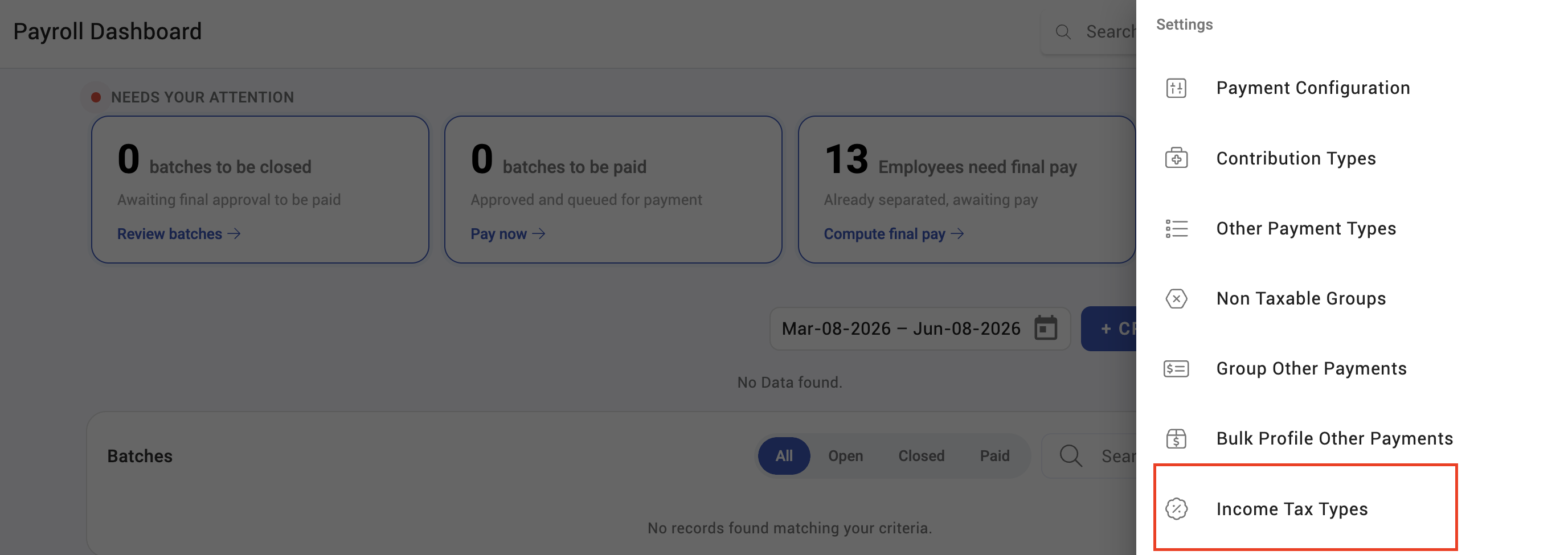
Where: Settings › Payroll › Income tax types You need: the payroll settings right
Before You Start
Tax rules are statutory. Take the rate tables and thresholds from the authority or your compliance adviser — KAMI applies what you configure.
Most companies need one income tax type. Create more only where a genuinely different regime applies to a group of employees, not to model exceptions.
What a tax type defines
Rate tables. Three of them: the monthly table, the annual table, and the termination table. Separation pay is taxed on its own table, which is why final pay does not resemble a normal month.
Deductible contributions. Two lists — employer and employee — naming which contributions reduce taxable income. This is where contributions and tax meet, and it is configured here rather than on the contribution.
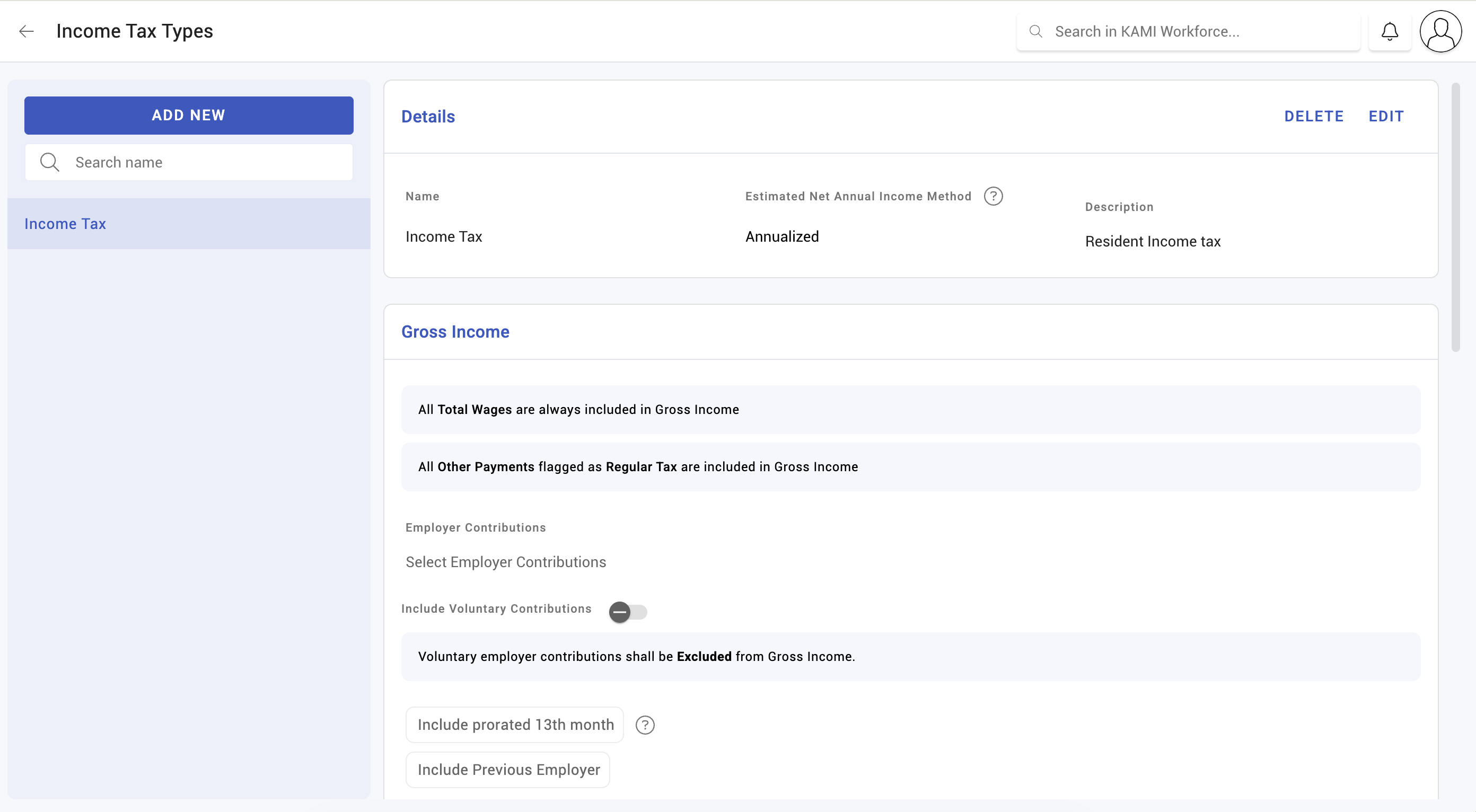
Estimated net annual income method. How the year is projected: Annualized, Forecasted, Reconcile, or Reconcile (Gross Up). This changes the month-by-month shape of withholding more than anything else on this page — see Payslip tax details explained.
Bonus treatment. A bonus tax deduction and the method used to apply it.
13th month handling. Whether 13th month is included in taxable income, and whether it is prorated, and on which wage basis.
Previous employer. Whether income from a previous employer within the same tax year is included. This matters for mid-year joiners, whose annual estimate is otherwise built from part of a year as though it were all of it.
Voluntary contributions. Whether they count as income and whether they are deductible.
Which one, when
| You need | Do |
|---|---|
| Standard tax for everyone | One type, marked default |
| A different regime for a group | A second type, assigned to those employees |
| A one-off correction for one person | A manual tax adjustment, not a new type |
How to configure a tax type
- Open Settings › Payroll › Income tax types.
- Create the type and name it for the regime it represents.
- Enter the monthly, annual and termination rate tables.
- Select the deductible employer and employee contributions.
- Choose the estimated net annual income method.
- Set the bonus and 13th month treatment.
- Decide whether previous employer income is included.
- Mark one type as default.
What Happens Next
- Tax is computed at calculation and stored on the payslip. Editing a tax type does not change payslips already calculated.
- Because tax is annual, a change part-way through the year affects the estimate from that point forward — earlier periods are not restated.
- Year-end reporting reconciles what was withheld across the year against what was due.
Tips
- Check the estimation method before your first December, not during it. Annualized and Reconcile behave very differently at year end, and the difference is most visible in the final payslip of the year.
- Verify one employee at each tax bracket by hand before going live. A rate table typed one row out is invisible until it is not.
- Turn on previous-employer income if you hire mid-year. Without it, a September joiner's annual estimate is wrong and their withholding with it.
- Keep the number of tax types small. Every additional type is another set of tables to maintain when rates change.
- Diary statutory changes. Rate tables change on known dates and nothing in KAMI will remind you.
Troubleshooting / FAQ
Q: Tax looks wrong for everyone by a similar proportion. Check the rate table against the authority's, row by row. A single mistyped bracket boundary does this.
Q: A contribution is not reducing taxable income. It is not in the deductible list on the tax type. That list is here, not on the contribution.
Q: December's tax is very different from other months. A reconciling estimation method is squeezing out the year's over- or under-withholding.
Q: A mid-year joiner's tax seems too low. Their annual estimate may exclude previous-employer income. Check that setting.
Q: Can one employee use a different tax type? Yes — assign it on their payroll settings. Use this for genuine regime differences, not for corrections.
Screenshots
These screenshots came from our previous help centre and may show an earlier version of the interface.