Goals and KPIs: how progress is calculated
A goal in KAMI is measured by its KPIs, and its priority decides how much it counts. Both of those are numbers, not labels, which is why a goal set carelessly produces a score that means nothing.
Where: Performance › Goals You need: performance rights to view goals
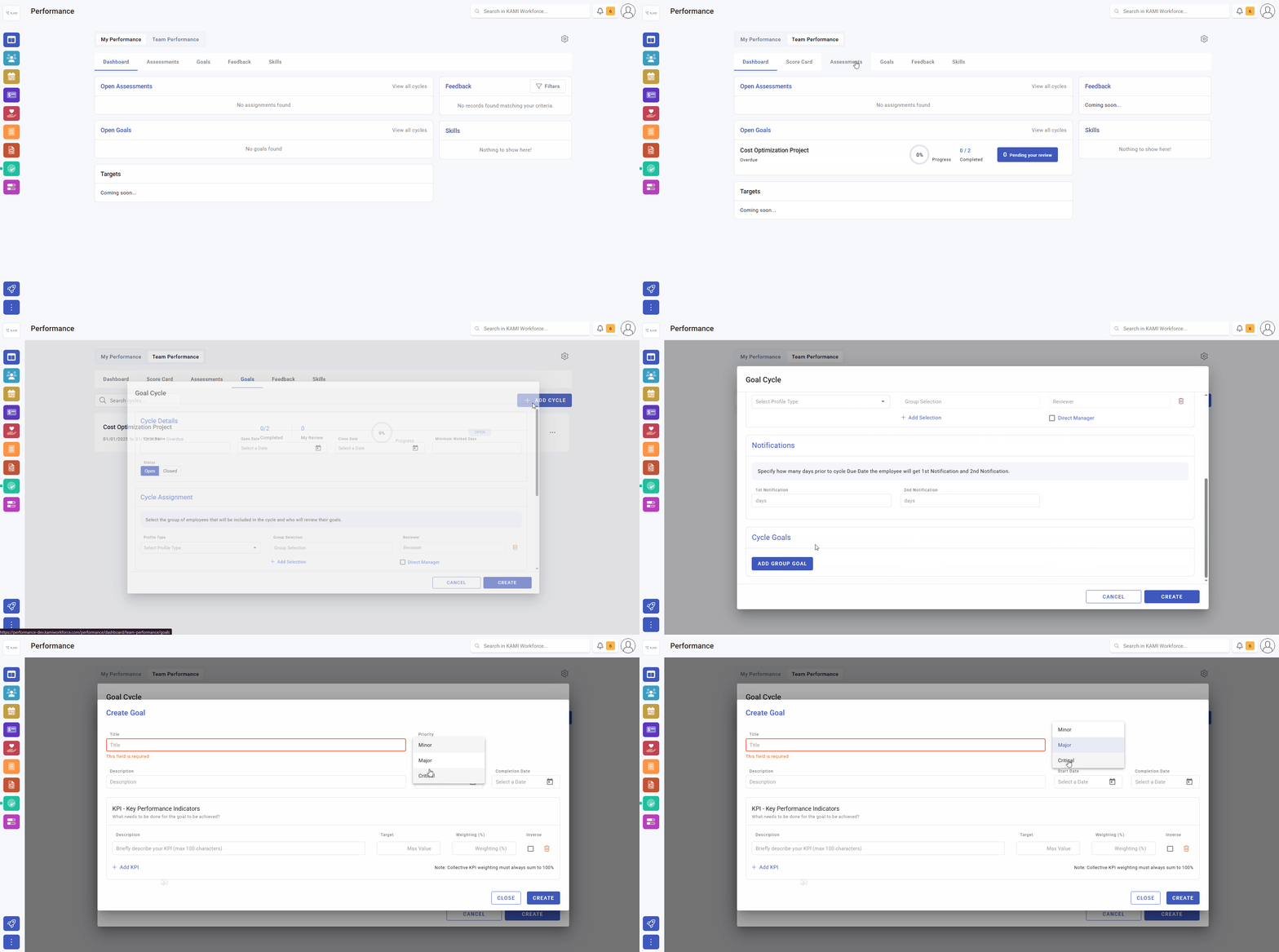
Priority is a weight, not a label
💡 A goal's priority directly weights its contribution:
| Priority | Weight |
|---|---|
| Critical | 1.0 |
| Major | 0.5 |
| Minor | 0.25 |
A Critical goal counts four times as much as a Minor one. Priority is therefore a scoring decision, not a way of expressing how the employee should feel about the goal.
The practical consequence: if every goal is set to Critical, you have removed weighting entirely and each goal counts the same. If everything is Minor, the same is true. Weighting only does something when it is used to distinguish.
How progress is measured
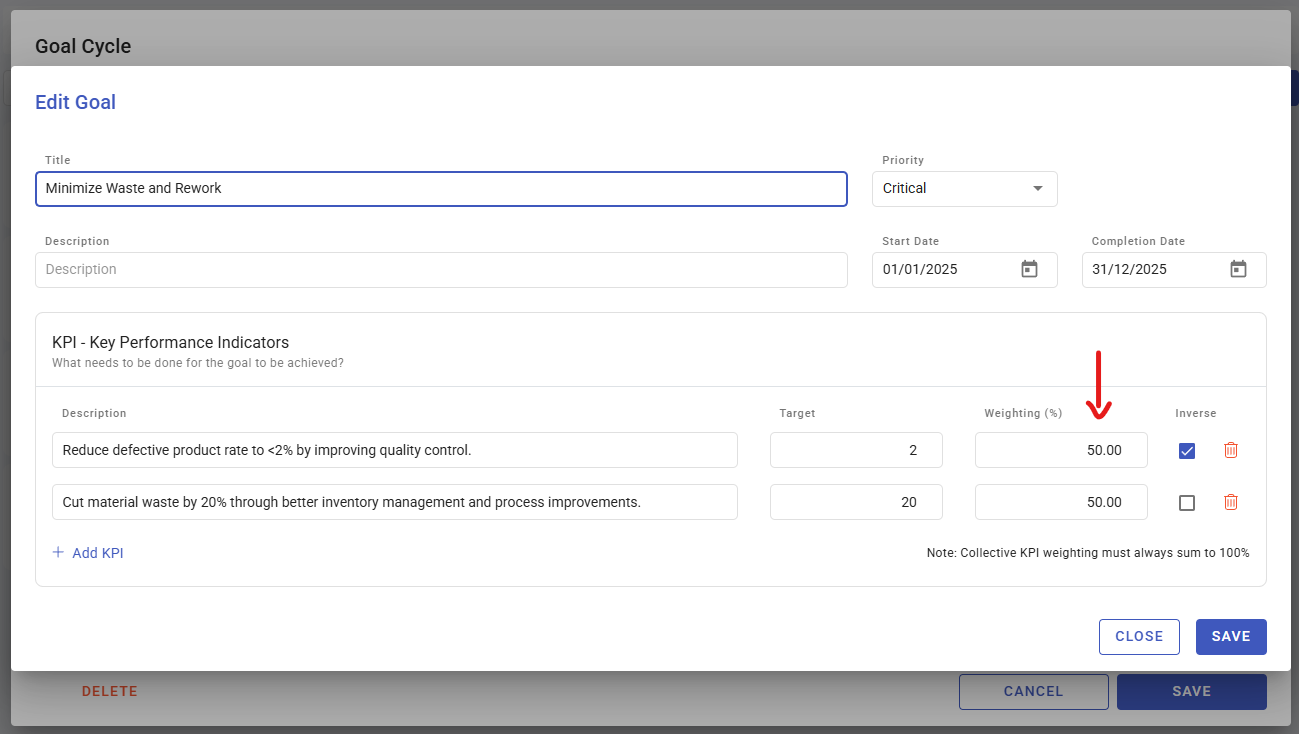
Progress comes from the KPI. Each KPI has a maximum value, and progress is recorded against it — so progress is the proportion of that maximum achieved, expressed against the KPI's own scale.
That means a KPI's maximum value is doing real work. A KPI whose maximum is set to something unachievable produces permanently low progress; one set too low shows completion early and stops being informative.
The four kinds of goal
| Type | Created by |
|---|---|
| Cycle | Applied cycle-wide to everyone |
| Personal | The employee adding their own goal |
| Assigned | A manager assigning a goal |
| Associated | Associating an existing goal |
Cycle goals are the ones to be careful with: they land on everybody, so a poorly specified cycle goal is a poorly specified goal for the whole company.
Ratings
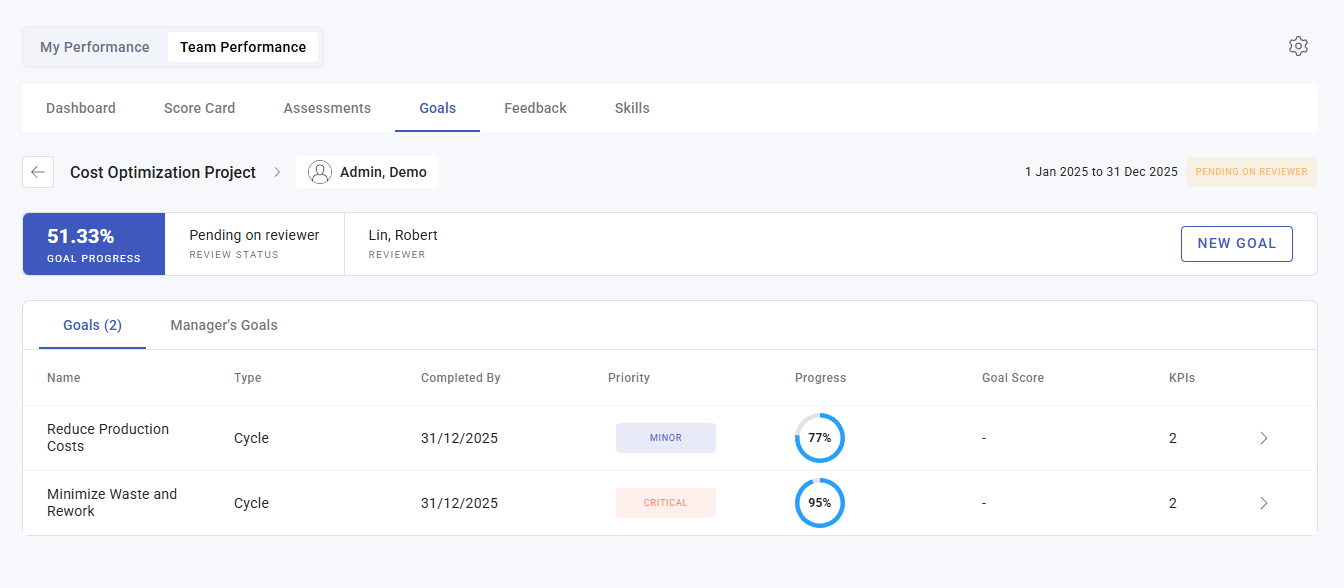
A reviewer rates a goal from 1 to 5. That rating is what flows into wider performance reporting — see Performance scores and the talent grid.
What Happens Next
- Progress updates as KPI values are recorded.
- Priority weighting applies wherever goals are aggregated into a score.
- Reviewer ratings feed team reporting and the talent grid.
- A goal's cycle status moves from pending on the employee, to pending on the reviewer, to completed.
Tips
- Use all three priorities deliberately. If everything is Critical, weighting is switched off and the score cannot distinguish between goals.
- Set KPI maximums to something achievable and meaningful. The maximum is the denominator of every progress figure.
- Write KPIs that are numeric and checkable. "Improve customer satisfaction" cannot be measured; "achieve a CSAT of 4.2" can.
- Review cycle goals harder than personal ones. They apply to everyone, so an ambiguity is multiplied by your headcount.
- Agree goals before the cycle starts. A goal added late has less of the period to be achieved in, and that is rarely reflected in the rating.
Troubleshooting / FAQ
Q: Two employees hit the same targets but scored differently. Check the priorities on their goals. A Critical goal counts four times a Minor one.
Q: Progress is stuck at a low percentage. Check the KPI's maximum value. Progress is measured against it.
Q: A goal appeared for everyone unexpectedly. It is a cycle goal, which applies to the whole cycle.
Q: Can an employee set their own goals? Yes — personal goals. Whether they count toward review is a matter of how you run your cycles.
Q: We changed a goal's priority mid-cycle. Its weighting changed with it. Avoid this once a cycle is under way.
Related articles
Screenshots
These screenshots came from our previous help centre and may show an earlier version of the interface.